Posts

Outcomes - 3

Image
Outcome 3: Too Mush(room) Marbling This piece I created using thick layers of metallic acrylic paint and repeatedly swirling it and applying more paint until the process covered the entire canvas. Whilst waiting for this to dry I painted a watercolour fungi woman and stuck her to the painting using the wet paint.  Once the piece was dry I added the art nouveau style border to add a sense of place to the piece.    I purposely left out the usual motif usage that I go for so as to let the colour marbling to shine through. This is also why I left the detailing to the very edges of the art so as to maximise the amount of background that can be seen. This piece was less about message and more about aesthetically pleasing art that I am proud of and enjoy looking at, however it still holds elements of things in my other art works that I also find pleasing, such as the art nouveau and the fungi woman. 

Outcomes - 2

Image
 Outcome 2: Shrouded in colour This piece was time consuming in the fact that I had to spend time slowly dripping the acrylic paint down the canvas in layers, over the top of an oil painted skull. This mimicked the earlier marbling experiments but in a much larger scale. Over the top of this once I was satisfied with the texture and level of marbling, I painted my motifs on with black paint.  I decided that there would only be one eye due to the fact that there was no figure to the piece, only a skull which was subject to being viewed. This piece is more about the death of life, or the end of a cycle rather than the beginning. I wanted to make that clear with more fungi growing from the skull area as well as the dripping paint over the top of elements to further the idea of covered decay.  

Outcomes - 1

Image
 Outcome 1: The birth of the feminine This was a final piece I created on an A1 sheet of plywood. I covered the background with scraps of paper I found laying around in storage in my house to create texture. I stuck this down using PVA. Over the top of this I used a sponge to spread gold and copper paint over the top.  On separate watercolour paper I painted one of my fungi women and cut her out, before using more acrylic paint to stick her in place and create an almost explosion effect around her.  On further separate sheets of paper I used oil pastels and acrylic paint to create skulls which were also cut out and stuck to the bored using paint.  After waiting for this to dry, I used metallic paints to drip down the canvas as well as painting eyes and mouths on the bored in keeping with my motif usage.  Around the edge I used an art nouveau border to create definition and show the piece as finite and boxed in. All of these elements brought together create a whi...

Prints and Printing

Image
Prints and Print making Motif follows a lot of my work and for this I thought that experimenting with printing would perhaps make for interesting concepts. Prints allow you to make multiples of the exact same thing without too much by my of discrepancy between each print.  For this I also wanted to start working in more of the art nouveau elements that I found so aesthetically appeasing so as to create prints that would look good wither on their own or as a group.  My first print was one of my fungi women which I carved into lino and printed in red ink - the colour of the fungi cap that adorns her head. I wanted this to be more messy looking and whimsical, like she appeared out of the ink blob itself, so I decided to be lose with how I applied the paint to the lino block she was carved into, creating this effect; For the next set of prints I wanted something more professional to look at, so I worked out a simple, yet elegant design on paper before hand to transfer onto my lino...

Photography Drawing

Image
Photography collage Photography is a large part of how I think about creating my work, so it seemed logical to use this as a base for collaging elements together to create larger works. For this, I once again took a large sheet of black paper and painted on the background in large swirling motions, choosing to keep some of the black visible through the acrylic paint. I then printed out the photographs and stuck them all lined up on a white sheet of paper and drew designs over the top of them in marker and POSCA pens. After this I cut out each individual photograph once again and arranged them on the background paper which was now dry. I used hot glue to stick them down so they were as flat to the paper as I could manage.  I really enjoyed creating this work as it combined both my love of photography and the collage effect that I have been experimenting with. I liked the freedom of colour I allowed myself as well as the added detail photography allowed. My only criticism to myself i...

Black Paper Drawing

Image
 Black Paper Experiments: For the following I used a blank sheet of thin black card and allotted myself certain implements to experiment with over various sheets. These included: Other paper types Glue (PVA) Hot glue (from glue gun) Acrylic paints POSCA pens Grey Scaled marker pens Pencils (2B, 4B, 6B and 8B) Sponges Paint Brushes The following are the outcomes of these experiments. For this, I used acrylic paint and a sponge to apply thick layers of metallic and white acrylic paint to form a base of swirling and random patterns to create thick texture and interesting colour mixes. On top of this I cut a circle out of a separate sheet of black paper and drew my usual motifs (eyes, mouths and fungi as well as skulls) onto this in a circular, overlapping motion. On a separate sheet of white paper I drew a ball python with grey scale marker pens to create definition.  To put all these elements together I used more of the metallic paint as well as PVA glue. This created an interes...

Abstract and Colour Sketching

Image
 Sketch experiments: Having decided on using the fungi women as a focal point for my art, I needed to work out a method for which to best showcase them as well as create a motif to cover them as this is something I find aesthetically pleasing. I wanted to use disembodied facial features similar to how both Villalba and Bacon do to create an uncanny and whimsical feel to the art. The following are experiments to see how best to create these works and the best materials to do so to create texture and movement. For this I allowed myself to use pens and pencils to sketch as well as figure out the best scale for this work to take place on. I also tried out different shapes of paper, seeing is circles created interesting viewing windows for my figures to occupy. 

Colour Paint Experiments

Image
  Colour Experiments Following are my paint experiments to try and find an interesting and creative method of making a back drop to place art onto, rather than relying on a plain background. I wanted to try and create more texture in my work and feel a more colourful, abstract background could help me achieve this.  Firstly I started out with acrylic paint and pushed it around the page from a central point with only a sponge. I noticed however that when the paint was allowed to run freely it created a marbled effect that I found aesthetically more appealing than the smeared effect achieved by the sponge. For this I spread acrylic paint in the centre of the page directly from the bottle and repeatedly tipped the paper up and down in a singular direction to create a linear marbled effect. The way the colours shone through each other was interesting to me and created a softer effect than my previous experiment. For this one I used circular motions to tip the paint where I wanted ...

Sympathetic Magic - Pitt Rivers Museum

Image
 Sympathetic Magic Pitt Rivers Museum - Oxford Links used to find and learn about the exhibit: https://romanmagic.wordpress.com/2016/06/10/magic-the-pitt-rivers-museum-a-reflection/ https://guerillaarchaeology.com/resources/witches-magic-and-medicine-pitt-rivers-museum/ https://romanmagic.wordpress.com/2016/06/10/magic-the-pitt-rivers-museum-a-reflection/ https://web.prm.ox.ac.uk/england/englishness-Object-biographies-details.html The sympathetic magic exhibition is a collection of artefacts from around the world used in rituals of magical or spiritual nature. The collection was put together by General Augustus Pitt Rivers and was donated to Oxford University. T he  Pitt Rivers Museum   is a free, public display space incorporating the 18,000 or so archaeology, anthropological and ethnographic objects donated to Oxford University by  General Augustus Pitt Rivers   and, subsequently, thoroughly expanded to over half a million individual objects....

Mushroom women - "Fungirls" series - Watercolour, pen and pencil

Image
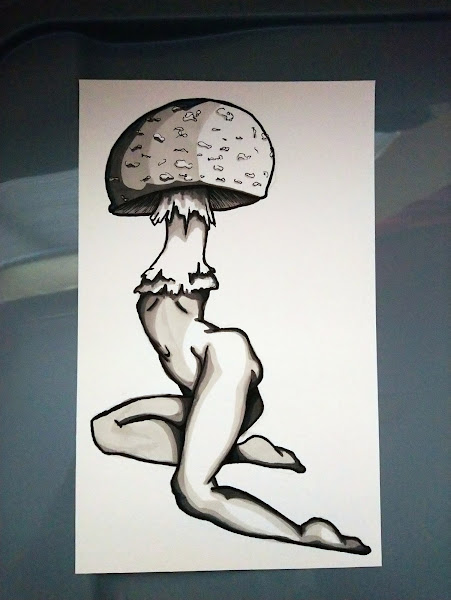
  The "FunGirls" Moving forward with the "fungirls" I decided that colour was something I wanted to add, but I didn't want to make the colours too bright because I wanted to make the figures still seem whimsical and fantasy-esque. This lead me to using watercolour to keep a washed out effect as well as then defining key details using both fine liner pens and darkening certain areas with pencil. I did this to create more shadow and make them seem more real on the page. The made me feel a lot happier to look at, the colours added a level of happiness to the figures and made them seem more alive, rather than something that haunted my dreams.  I tried to use reference imagery from real mushrooms that exist in the world and my own photography to create a further link between myself and them. These have become a mild obsession of mine through my art and I really want to now experiment with them in more abstract areas to see their visual interaction and create textural...

Mushroom women - "Fungirls" series - Pen originals

Image
The "FunGirls" The "fungirls" evolved from a play on words with fungi and girls after I drew women that appeared to me in a dream after I had been taking a large amount of mushroom pictures. In the dream I was lying in bed in the forest when mushrooms started to grow around me until they were approx. knee height. They then started sprouting feminine bodies and dancing around my bed. After a time they sank back into the forest floor and I jolted awake. From there I started drawing in the early hours of the morning with what I could find which happened to be grey scale pens. These area are a few examples of the work I created at this point. I made a point of highlighting the shadows and creating high contrast with the pens as well as finer detail in fine-liners. I found the results quite interesting and made for both beautiful and somehow uncanny work.  I also find these particular ones quite eerie to look at simply because they remind me of the dream that I had...

Wunderkammer

Image
 Wunderkammer -  The Curio Cabinet https://www.moma.org/calendar/exhibitions/272 Wunderkammern , or cabinets of curiosities, arose in mid-sixteenth-century Europe as repositories for all manner of wondrous and exotic objects. In essence these collections—combining specimens, diagrams, and illustrations from many disciplines; marking the intersection of science and superstition; and drawing on natural, manmade, and artificial worlds—can be seen as the precursors to museums.  Interesting writing  work found: https://www.rct.uk/collection/themes/trails/wunderkammer-cabinet-of-curiosities Wunderkammer  is literally translated from German as a 'room of wonder'. In English it is usually referred to as a 'Cabinet of Curiosities'. Many  Wunderkammer  originated in royal treasuries, where the crown jewels and items of regalia were housed with other items of value for safekeeping. However, the idea of a  Wunderkammer  was fully born in the sixteenth ce...

The Uncanny

 The Uncanny https://www.freud.org.uk/2019/09/18/the-uncanny/ One hundred years ago, Sigmund Freud wrote his paper on ‘ The Uncanny ’ (Das Unheimliche). His theory was rooted in everyday experiences and the aesthetics of popular culture, related to what is frightening, repulsive and distressing. The paper tackles the horrific concepts of inanimate figures coming to life, severed limbs, ghosts, the image of the double figure(doppelgaengers) and lends itself to art, literature and cinema. In the second part, Freud begins to tackle people, things, self-expressions, experiences and situations that best represent the uncanny feeling. Freud’s paradigm example is the short story of  E.T.A. Hoffmann’s ‘The Sandman’ , a tale that parents would tell their children to encourage them to go to sleep. The story goes that the child must be asleep for the Sandman to put sand in the child’s eyes – if they are not asleep, the Sandman will take out their eyes. The protagonist is a boy named...

Myths, Folklore and Fairy Tales

Image
  Myths, FolkLore and Fairy Tales When looking for inspiration I tried to be loose with how I found it. That being said, I drew a lot of inspiration from Folklore and mythology to create an interesting and built up world within my art that may or may not be seen from the surface. I love the idea of the whimsical and beautiful, as well as these things eventually being peoples downfall.  The Fae https://faefolk.weebly.com/lesson-1-1.html The fae folk or faeries or simply Fey, are creatures with magical ability. Now they don't all just spontaneously combust into magic, mind. Some have blatant supernatural powers (changelings, sirens, domovoy). Others are magical solely by their very existence (giants, trolls, ogres). But there is no denying the fact that most faeries are closely linked to the magical powers imbued by nature. That is perhaps why the elemental classifiers exist. Faeries are referred differently across the world. In Western Europe, they are "faeries," "the...